| Expedition
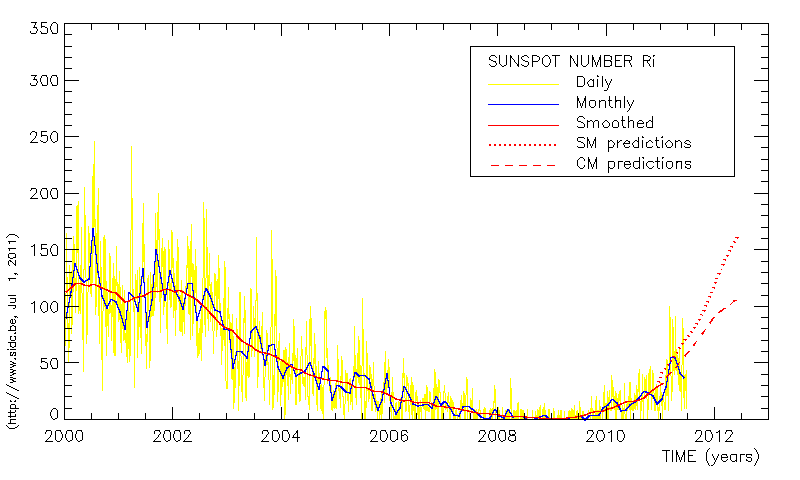
The Objective The principal objective of Shelios 2011 will be the observation of the aurora borealis from the south of Greenland, coinciding with the increase in solar activity. The Phenomenon According to latest predictions, the Sun will start its 24th period of solar maxima in the beginning of 2013. Solar activity is defined by the number of sunspots detected on the surface of the Sun. As we approach the maximum, the number of sunspots increases, as shown in Fig. 1.
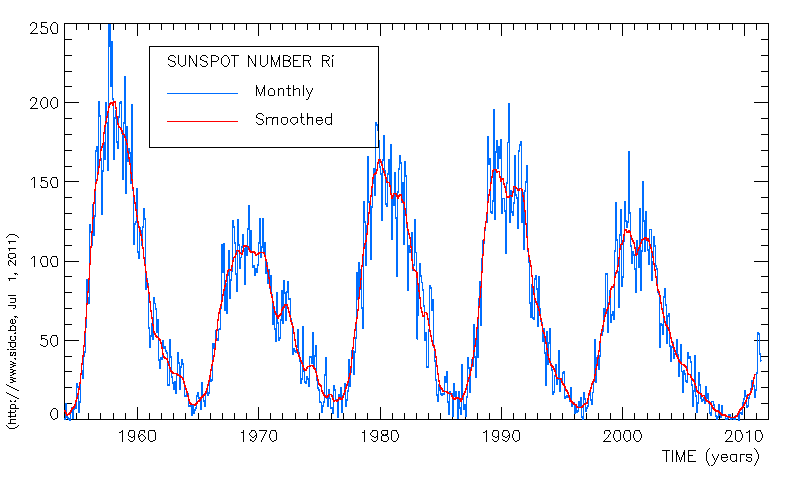
Figure 1.- Solar activity plot (sunspot number against time). The first maximum corresponds to the last solar maximum (during the end of 2000); predictions indicate that the next maximum will occur in the beginning of 2011.(SIDC) From the statistics of the last 200 years it is known that the solar maxima (maximum of sunspots) follow a cycle of approximately 11 years (see Fig. 2).
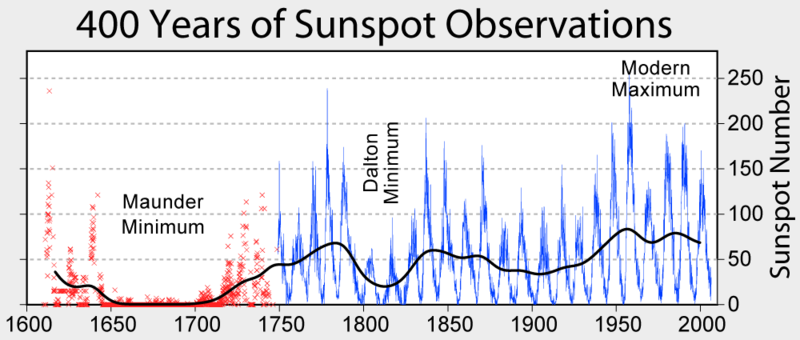
Figure 2. - Solar activity during the last 100 years (number of sunspots on the surface of the Sun against time). (SIDC) One of the consequences of the solar maxima is that the Sun increases the emission of very energetic elementary particles (solar wind) in what is called solar storms. The main effects the solar maxima have on Earth are: 1) Interference problems in communications networks (terrestrial and satellites). 2) Possible problems with electricity supply due to the massive arrival of electrons at the terrestrial surface. 3) Possible effects on the terrestrial climate. 4) Increase in frequency and luminosity of polar auroras. In the 1989 solar maximum, and during intense solar storms, several cities in the north of the United States and Canada had serious problems with electricity supply. Several satellites also suffered temporary anomalies in the course of these storms. The relation between solar activity and terrestrial climate has been a subject of debate in the last few years. There are indications that suggest that Earth has cooled down during the solar activity minima. Moreover, a prolonged solar minimum occurred between the years 1645 and 1715 (the Maunder minimum, see Fig. 3) and is thought to have provoked a small ice age, with its effects manifested in Northern Europe.
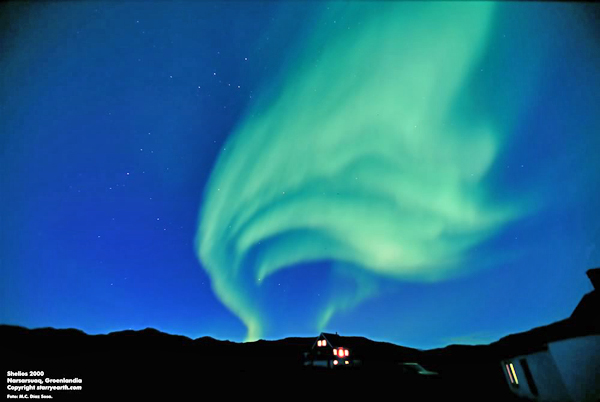
Figure 3. - Solar activity during the last 400 years (number of sunspots on the surface of the Sun against time). (R. A. Rhode, Global Warmimg Art Project) During the solar maxima the intensity of the solar wind increases, leading to an increase of flux of elementary particles arriving at Earth. These particles are directed towards the magnetic poles where they interact with the Earth’s atmosphere, causing the aurora borealis (Northern hemisphere) and the aurora australis (Southern hemisphere). The best zone to observe the aurora borealis is in a circle around the magnetic North Pole (between 60 and 70 degrees North). The magnetic pole does not coincide with the geographic North Pole and moves over time. It is currently located off the coast of the Canadian island of Ellef Ringnes, meaning that southern Greenland is well-placed to view the auroras. This wonderful celestial spectacle takes place when very energetic particles from the Sun reach the Earth’s atmosphere via the solar wind. The entrance of these particles is governed by the Earth's magnetic field and, therefore, they only can penetrate through the atmosphere at the North Pole (aurora borealis) and the South Pole (aurora australis). The auroras consist of luminous curtains, which change quickly and have several tones. The light emission takes place in the lower atmosphere (at altitudes between 100 and 400 km) and is a consequence of the collision of the solar wind (essentially electrons) with atoms of oxygen (greenish tones) or nitrogen molecules (reddish tones). Intense auroras were seen in 2000 (see Fig. 4) coinciding with a period of maximum solar activity. The solar activity cycle is approximately eleven years. As the Sun reaches its maximum activity during the end of 2011, we will be able to see the auroras unusual beauty.
Figura 4.- Una de las auroras fotografiadas durante la expedición Shelios 2000. (Starryearth.com, M. C. Díaz Sosa)
Shelios has chosen the south of Greenland as the destination to observe the northern lights between the 22nd and 31st of August 2011, in a similar expedition to the one the expedition Shelios 2000. Since most of the places where the expedition will take place were previously visited during the last expedition to Greenland, we will compare the photographs to observe the evolution of the glaciers during this decade, with the aim to observe the effects of global warming on these masses of ice. In the journal section of this website we shall be including the comparison of the photographs.
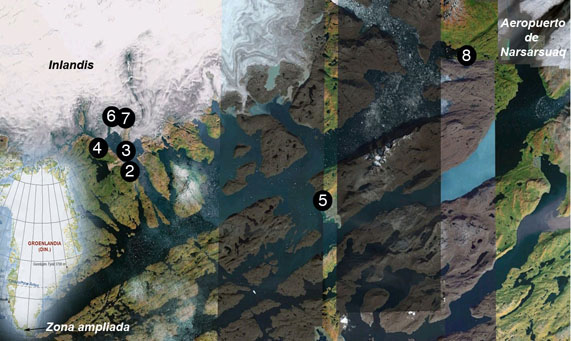
Figure 5.- Details of the locations of the expedition Shelios 2011. The numbers indicate the day of the expedition. (Shelios) The itinerary for the expedition is the following:
The expedition will be divided in 5 areas, which are explained below along with their tasks: · Science and Outreach: Astronomical observations and publicise the expedition. Shelios
2011 is coordinated and directed at all times by Dr. Miquel Serra-Ricart (Astronomer based at the Instituto
de Astrofísica de Canarias and administrator of the Teide Observatory). Last updated: 20th of August 2011. © Copyright 2011, Shelios®

|